
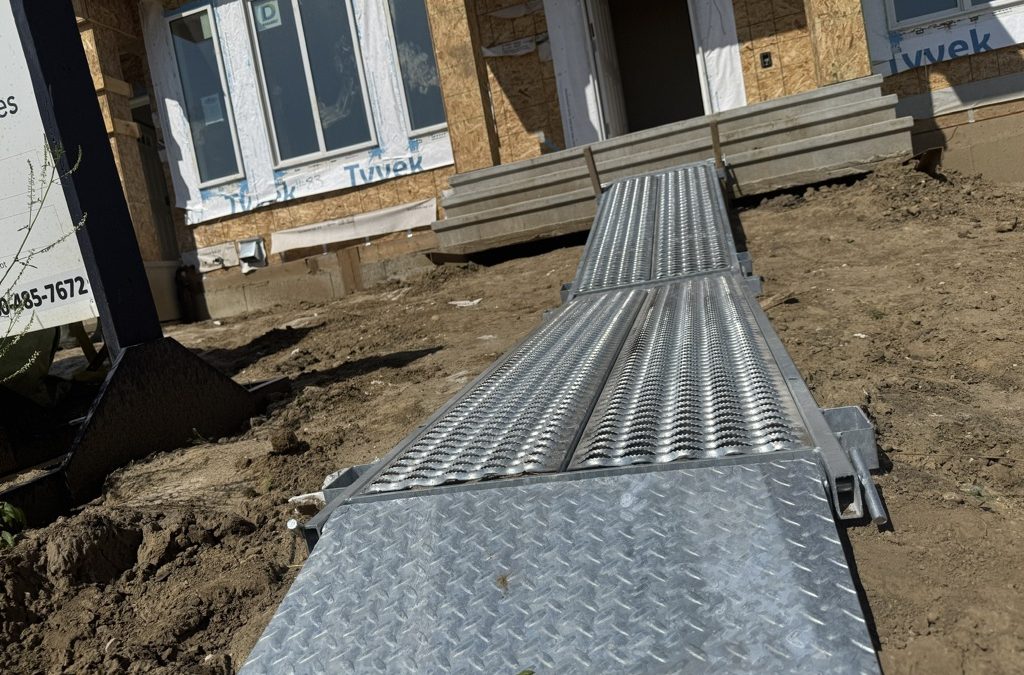
Having a temporary walkway on your job site doesn’t just make it safer; it can also keep your site cleaner and more orderly while protecting lawns from unnecessary damage. Whether it’s a home construction project or a larger commercial job, there are substantial benefits to installing temporary walkways in a province like Alberta where conditions can be unpredictable.
Key Takeaways
- Alberta OHS Code Section 121 requires job site walkways to be strong enough for expected loads, at least 600mm wide, and—depending on conditions—fitted with guardrails and a slip-resistant surface; FenceLine’s rental walkways are built to meet all of it.
- Temporary walkways pay for themselves fastest on sites with unfinished grading, excavation, or uneven terrain, public foot traffic, or upcoming inspections and open houses.
- Before renting, nail down your load type (foot traffic vs. equipment), site conditions, project length, accessibility needs, and how the walkway ties into your existing perimeter fencing.
- Renting is typically cheaper and lower-liability than improvised fixes like plywood or gravel, and FenceLine’s modular planks (2 ft × 6 ft) can be reconfigured as the site’s needs change, with delivery in 24-48 hours.
Why Temporary Walkways Matter on Alberta Sites
Temporary walkways might just be more useful on Alberta job sites than anywhere else. In a province where temperatures regularly drop below freezing at night but rise rapidly during the day, the ground can freeze and thaw, creating a mess on sites. That’s especially true in spring, where mud becomes a serious hazard and a challenge for workers.
Providing a safe, stable, and clean walkway makes working on-site easier and ensures your site complies with Alberta Occupational Health and Safety regulations.
Section 121 of the OHS code dictates that employers must ensure that a walkway is:
(a) is strong enough to support the equipment and workers who may use it,
(b) is at least 600 millimetres wide,
(c) is wide enough to ensure the safe movement of equipment and workers.
(d) has the appropriate toe boards and guardrails required by Part 22.
121(2): An employer must ensure that the surface of a walkway, runway or ramp has sufficient traction to allow workers to move on it safely.
Our OHS-compliant walkways meet these standards and keep you compliant while protecting grade and keeping crews and inspectors moving.
When You Actually Need Temporary Walkways

It’s true that not every job site will need temporary walkways, at least not for all 12 months of the year. There are, however, many jobs where a construction walkway can transform a site. These include:
- New builds with no finished grading or sidewalks. These sites can get muddy and uneven quickly as vehicles enter and exit the property, so a temporary walkway rental provides safe access for workers.
- Sites with excavation, trenching or uneven terrain near pedestrian paths. Modular walkway systems can prevent slips, trips and falls in these environments.
- Public facing sites. Any job sites where you’re near sidewalks or building entrances, and where the risk to passing pedestrians is higher, can benefit from providing safe passage.
- Multi-trade sites with heavy foot traffic between different areas. In these situations, temporary walkways can actually help guide workers to the areas they need to be and prevent them from going to areas where they shouldn’t be.
There are other times where setting up temporary walkways for a short period can be beneficial. If you’re doing site tours, have upcoming inspections or are hosting a public open house, a construction site walkway keeps people safe and helps direct pedestrian flow.
How to Spec Them Right: Key Questions to Answer Before Renting
Do you need temporary walkways? What are the specifications of your site and how could they be useful? Before you make decisions on securing construction walkway rentals, ask yourself these questions:
- What type of loads will need to move across the walkways? Will it be primarily foot traffic or will your site require pathways for light equipment or wheelbarrows?
- What conditions will the site present? Factors such as grade, drainage, mud, and ice can impact whether temporary walkways are needed.
- How long will the work take? This can impact the materials you want for your walkways and whether changing conditions will make them necessary.
- Is my site accessible? Ensuring that your site is accessible will keep you compliant, and choosing OHS-compliant walkways should include considerations on width.
- What weather will you be dealing with? The conditions in Alberta are challenging, so your site will need durable, weather-resistant walkways.
- What existing fencing is there? You need a continuous perimeter of temporary fencing around your job site, with entrances and exits. The walkways should be designed to guide pedestrians from those entry points to the areas where they’re needed.
- How will the walkways be installed and removed? FenceLine will install and remove your walkways while causing minimal site disruption.
- Is compliance documentation required? If so, it’s important to ensure that any rental company can provide you with the documents you need.
Why Rent Instead of Improvising

When conditions get challenging on a job site, it can be tempting to come up with an in-the-moment solution like laying down plywood over an area that’s become muddy after ice has melted. Building a gravel path might seem like an obvious way to prevent those conditions, but the reality is that it’s often cost-prohibitive compared to renting temporary walkways.
Cost isn’t the only advantage to temporary walkways when compared to other improvised solutions, though.
- Our temporary walkways come with a plank, transition plate, ledger plate and clamp plate. They are 2’ wide and 6’ long.
- Their modular design allows them to cover any site size and can be adjusted as your jobsite’s needs evolve.
- You reduce your liability when compared to makeshift solutions like laying down plywood. They can be properly inspected.
- You can add optional handrails to provide additional support
How FenceLine Can Help
When you rent FenceLine’s temporary walkways, you don’t just get an OHS-compliant walkway system that’s built to withstand Alberta’s challenging conditions; you provide safe access for pedestrians and workers across your job site.
We deliver across Alberta. Request a site assessment or get a quote today.
FAQ
Are temporary walkways legally required on Alberta job sites?
Temporary walkways are not legally required on Alberta job sites, but employers are required to provide safe access and are liable if workers or pedestrians slip and fall. When conditions are less than ideal, and there is ice or people are wondering how to cross a muddy job site, temporary walkways make a huge difference.
How much weight can a temporary walkway handle?
Our temporary walkways are designed to support predictable foot traffic, but any heavy equipment should take alternative routes. Our walkways are built from contractor-grade, hot-dipped galvanized steel.
Can temporary walkways be used in winter conditions?
Absolutely, temporary walkways can be set up above snow and ice to provide a safe and stable surface.
How long can I rent a temporary walkway for?
You can rent a temporary walkway from FenceLine for as long or as short as your job site requires.
Do temporary walkways need to meet accessibility requirements in Alberta?
Temporary walkways are commonly used to improve accessibility at events and job sites and they create a clear, stable pedestrian path.